1970 · Dodge · 70s
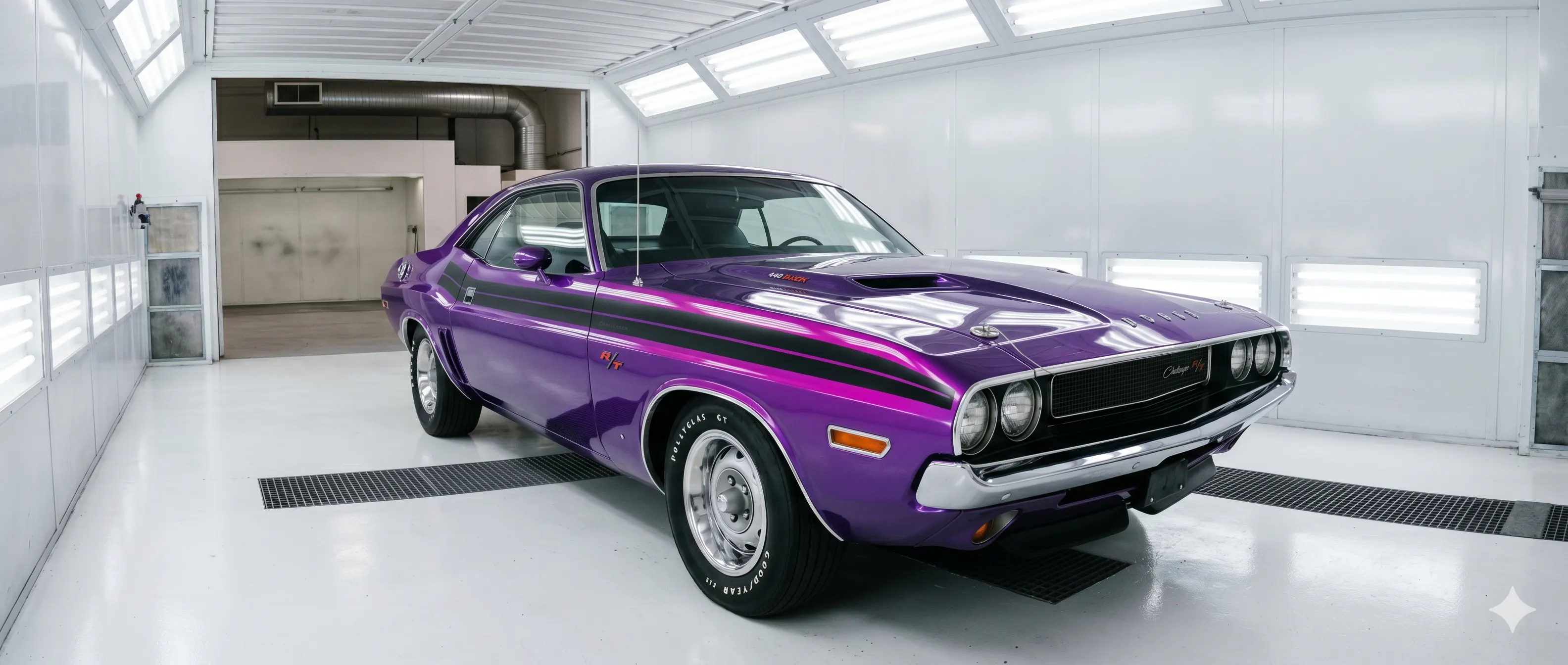
1970 Dodge Challenger R/T — Plum Crazy Purple
The owner's brief was to make it look like it just rolled off the Hamtramck line in 1970 — but better. Plum Crazy Purple matched to within a single delta-E unit; factory-correct hockey stripes hand-laid in flat black.
Background
Plum Crazy is one of the most technically demanding muscle-car colours on the planet. The original Chrysler formula used inter-metallic flake that’s no longer manufactured. Modern reproductions either read too pink (too much red interference) or too blue (too much violet). Getting it wrong is immediately obvious to any E-Body owner at a show.
Formula Development
We started with spectrophotometer readings from three independently verified matching-numbers cars: a hardtop in California, a convertible in Michigan, and a car owned by a Chrysler historian who has the factory records. After 14 colour pulls, we reached a delta-E of 0.8 on all three reference cars under the same D65 light source — considered a match at industry standards.
The interference violet flake is the variable component. It shifts dramatically with spray angle and distance, so our booth setup was documented precisely and will be repeated for any future colour-matched repairs.
Stripe Work
Factory documentation shows the stripes were applied over the base colour before clear coat — giving them a flush, painted-in appearance rather than the raised edge of a vinyl appliqué. We followed this process exactly.
Width verification was done against the factory assembly manual using a reference car for cross-check. The Bumblebee stripe at the rear requires a 3 mm step across the quarter panel to body seam — a tolerance that separates correct cars from close cars.
Clear and Polish
Four coats of clear over both colour and stripes. The flat-black areas were masked and treated with a satin clear rated for 15-year UV stability. Final gloss measurement on the Plum Crazy panels: 94 GU at 60°.